Lower wall dead load
Lower density can support structural optimisation when the building is recalculated for the changed loads.
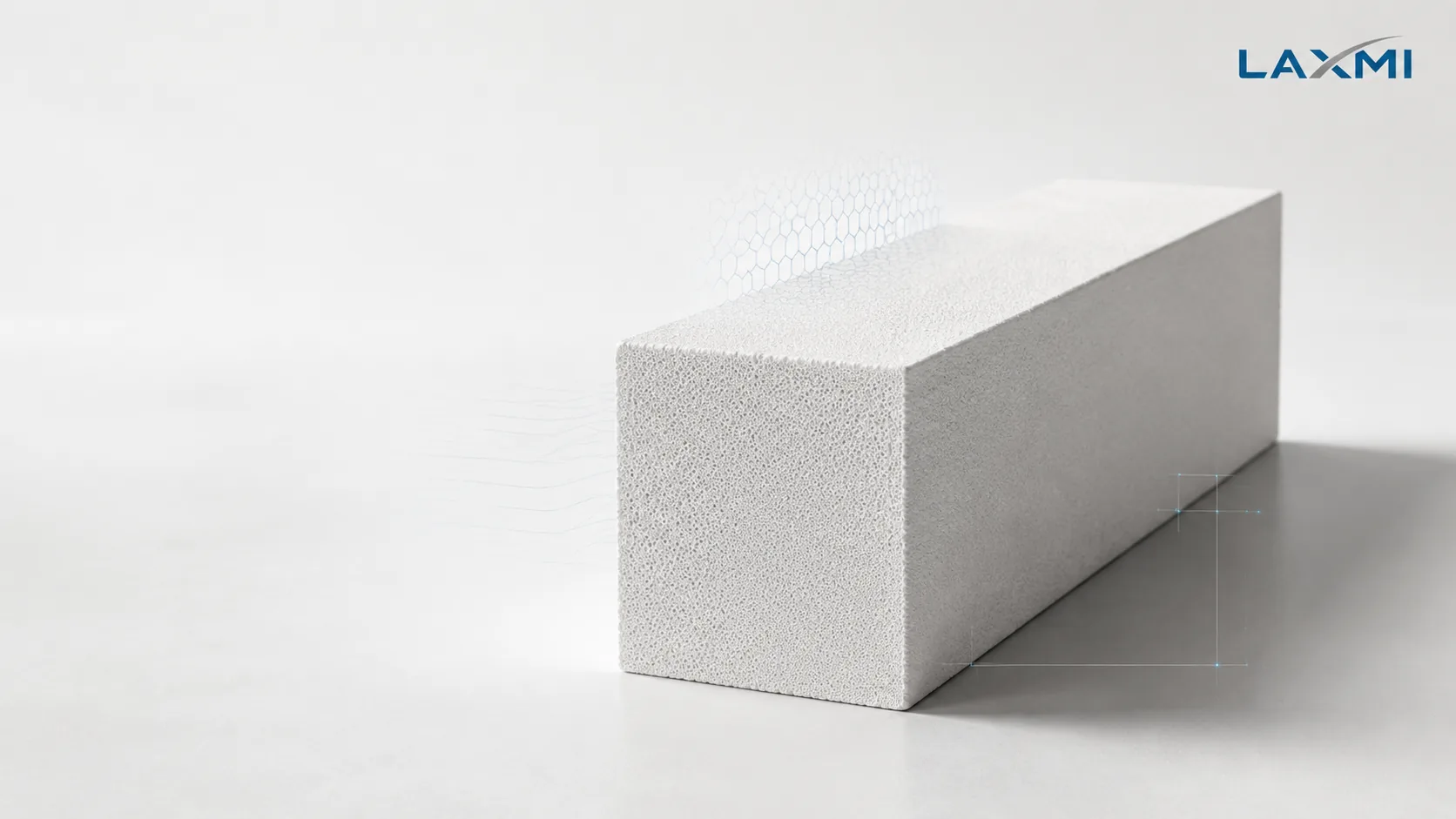
AAC Block · Product & Engineering Guide
AAC blocks combine low weight, useful thermal performance and factory-controlled dimensions. Their true value depends on product quality, wall design and consistent manufacturing.
Understand the material
Autoclaved Aerated Concrete is a lightweight, factory-produced masonry material. It is generally made from a silica source such as sand or fly ash, together with cement, lime, gypsum, aluminium powder and water.
Aluminium reacts in the alkaline mix and forms a cellular “green cake”. After pre-curing, the cake is wire-cut to size and cured with saturated steam inside an autoclave.
Hydrothermal curing develops hardened calcium-silicate-hydrate phases, including tobermorite. This is why AAC quality depends on the complete process—not on any single machine.
Material performance
These advantages are opportunities—not automatic guarantees. Building design, wall thickness, workmanship and tested product properties still determine the result.
Lower density can support structural optimisation when the building is recalculated for the changed loads.
The cellular structure generally reduces heat flow compared with denser masonry.
Wire cutting supports straighter walls and thinner, more consistent mortar joints.
Large, lightweight units cover more wall area and can be cut for openings and services.
Performance must be evaluated for the complete tested wall assembly, including joints and finishes.
Balanced assessment
Make a project-level decision
Both materials can perform successfully. Compare the complete installed wall—not only the unit price.
| Decision factor | AAC blocks | Red clay bricks |
|---|---|---|
| Wall load | Generally lower because of lower density | Generally higher for comparable wall volume |
| Thermal behaviour | Cellular structure generally reduces heat flow | Depends on brick density, type and wall thickness |
| Dimensions | Factory wire-cutting can provide controlled sizes | Variation depends on production method and supplier |
| Installation | Larger, lighter units can reduce joints and handling | Smaller units generally require more joints |
| Fixings | AAC-specific anchors may be required | Choice still depends on brick quality and load |
| Delivered economics | Evaluate block, freight, breakage, mortar, plaster and speed | Evaluate the same complete installed-cost factors |
Production defines performance
Raw-material changes, inaccurate dosing, unstable reaction, poor green-cake handling, cutting errors or an inconsistent autoclave cycle can affect density, strength, dimensions and saleable yield.
Automation adds value when it reduces variation, protects the product, improves traceability or makes handling more dependable.
For AAC plant investors
Installed capacity alone does not create demand. Define the product and operating reality before selecting machinery.
Indian product requirement
IS 2185 (PART 3):1984
This standard covers autoclaved cellular aerated concrete blocks and includes requirements related to dimensions and physical properties. Manufacturers and buyers should use the current official BIS listing and applicable conformity requirements rather than copied internet tables.
View official BIS standard listing ↗Laxmi En-Fab
We evaluate raw-material preparation, batching, mould circulation, cake handling, cutting, autoclaving and finished-product logistics around the required block quality and operating reality of each project.
Our approach is practical: identify where variation enters, define the variables that must be measured, and apply equipment or automation where it creates a clear improvement. The objective is stable, maintainable and saleable production.
Frequently asked questions
AAC offers lower wall load, useful thermal resistance, controlled dimensions and efficient installation. Results depend on product quality, design and workmanship.
AAC requires careful handling, suitable fasteners, correct moisture detailing and trained installation. Poor manufacturing or workmanship can cause breakage, cracks or finishing issues.
AAC offers advantages in weight, thermal behaviour and dimensional consistency. Red bricks may offer local availability and familiar workmanship. Compare the complete installed wall system.
No. Lower wall weight creates an opportunity for structural optimisation only when the structural design is recalculated around the changed loads.
Autoclaving provides controlled hydrothermal curing that develops the hardened mineral structure responsible for AAC’s final properties.
Planning an AAC plant?
Share your proposed location, project stage, target production range and raw-material status to discuss the right next engineering steps.
Discuss Your AAC Plant Requirement