Straight or L-shape
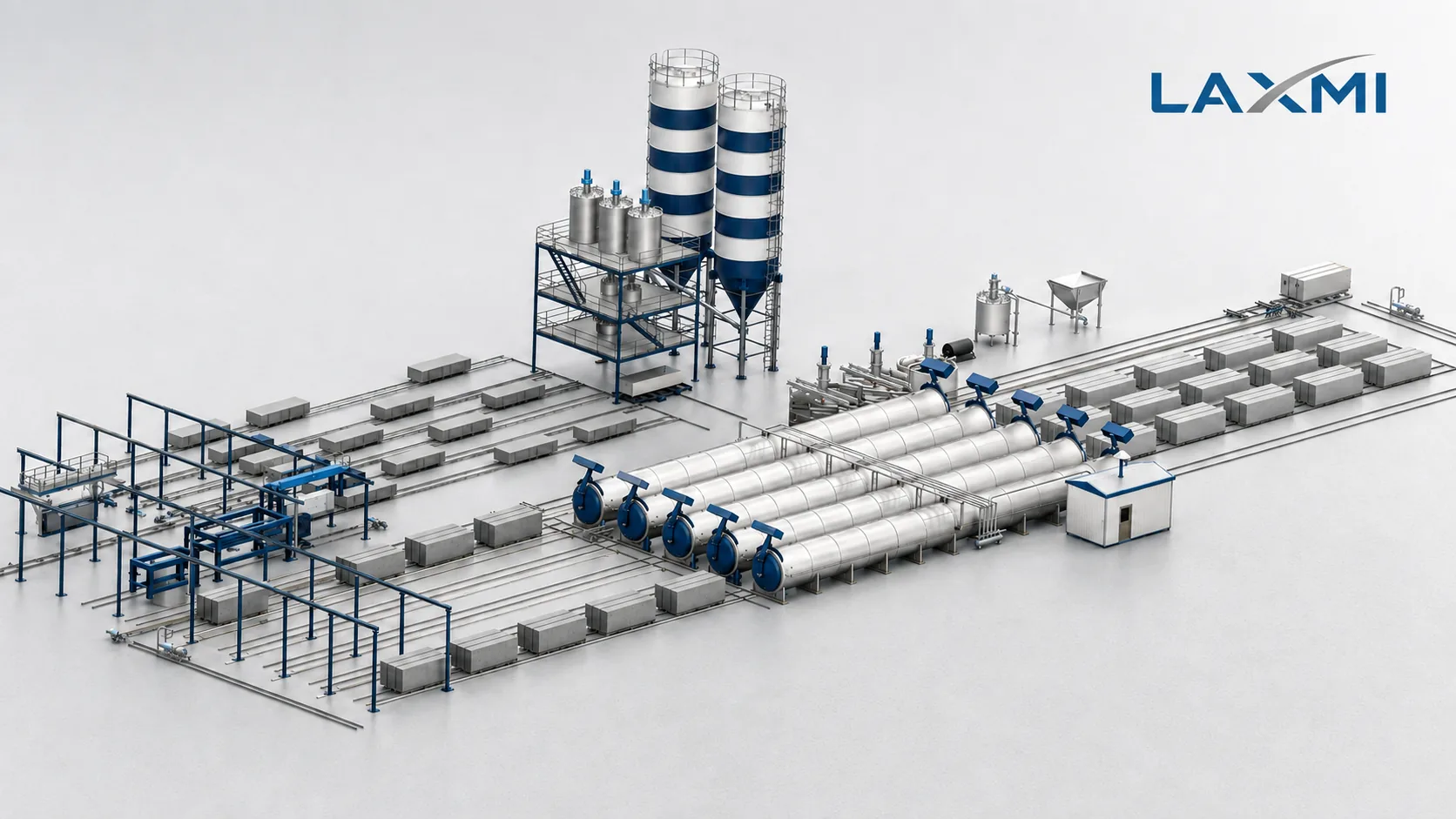
How the manufacturing stages are arranged across the available plot.
AAC Investor Academy · Design your plant
Choose the right factory configuration for your land, production flow and future expansion—not from a standard drawing.
Project-specific dimensions and output must be confirmed during engineering.
The direct answer
An AAC plant layout coordinates raw-material preparation, batching, casting, pre-curing, cutting, autoclaving, packing, utilities and internal movement. The right configuration is the one that meets the required output safely and maintainably within the project's verified constraints.
Two decisions. One complete system.
Straight and L-shape describe the direction of production. Single-door and double-door describe how autoclave trolleys enter and leave. They are separate decisions, but must be engineered together.
How the manufacturing stages are arranged across the available plot.
How trolleys are loaded, unloaded and returned through the curing area.
Start with verified inputs
Land shape matters, but so do product range, circulation, utilities, dispatch and expansion. These inputs define whether a concept can become an operable factory.
Boundaries, levels, roads and usable dimensions
Target output, product mix and operating plan
Storage, grinding, slurry and unloading requirements
Transfer systems, controls and operator access
Steam, power, water, air and condensate routes
Future autoclaves, moulds, storage and line capacity
Process-flow comparison
Option A
Often considered for long rectangular plots where the principal production stages can follow a predominantly linear direction.
Option B
Often evaluated when usable length and width allow one planned direction change to improve the overall site arrangement.
Engineering principle
Equivalent output can be designed in either geometry when the complete equipment and handling system is sized correctly. This must be demonstrated by the project layout and cycle calculation—not assumed from shape alone.
Autoclave arrangement
Door arrangement can influence building width, trolley movement, access and turnaround. It does not determine product quality by itself.
| Decision factor | Single-door / same-side | Double-door / through-flow |
|---|---|---|
| Trolley movement | Load and unload at one end | Load at one end, unload at the other |
| Building arrangement | May suit restricted width | Requires working access at both ends |
| Handling sequence | Return and sequencing are critical | Through-flow can be more direct |
| Turnaround | Calculate for the actual system | Calculate for the actual system |
| Capacity conclusion | Requires full bottleneck analysis | Requires full bottleneck analysis |
Civil, PEB and operating implications must be quantified project by project. Fixed savings or cycle-time claims should not be assumed.
The factory is a circulation system
Empty moulds, side plates, pallets and trolleys must return without blocking production.
Steam, condensate, electrical, water and compressed-air routes need safe access and expansion capacity.
Moving equipment and pressure vessels require controlled access, isolation and removal space.
Packing, inventory, forklift movement and truck turning determine the real finished-goods area.
Plan phase two in phase one
A future-ready layout identifies what will be added, how it will connect and where installation affects running production.
Avoid expensive corrections
Laxmi En-Fab approach
The purpose is to develop a coordinated machinery arrangement—not apply one standard drawing to every project.
Survey and project requirements
Capacity, product and automation
Material, trolley and vehicle movement
Flow and autoclave arrangements
Civil, utilities, safety and expansion
Selected concept before execution
The exact drawings, calculations, responsibilities and approval stages included in supply must be defined in the project's technical-commercial proposal.
Frequently asked questions
There is no universally best layout. The correct choice depends on the surveyed plot, production target, product mix, automation, transfer system, utilities, dispatch planning and future expansion.
A straight layout keeps the main production flow predominantly linear. An L-shape layout changes direction once to use available length and width. The selected handling system must support the chosen geometry.
No. Layout shape does not by itself determine block quality. Quality depends on raw materials, batching, process control, pre-curing, cutting, autoclaving and consistent operation.
Equivalent output can be designed in either geometry when the complete machinery and handling system is correctly sized. Capacity must be confirmed by project-specific cycle and bottleneck calculations.
Not automatically. Same-side loading can suit projects with width constraints, but handling and turnaround must be calculated. Through-flow arrangements also require sufficient access and infrastructure at both ends.
The number depends on target output, load per charge, curing and handling time, operating hours, availability, mould and trolley circulation, steam supply and other line bottlenecks.
Share the surveyed plot drawing, gate and road details, project location, target capacity, block or panel plan, raw-material basis, preferred automation and future expansion target.
Before you freeze the land or machinery
Share your surveyed plot, production objective, product plan and future expansion requirement. Laxmi En-Fab's engineering team can define the next planning stage and inputs required for your project.