Mould box
Contains the poured mix during rising and initial setting.
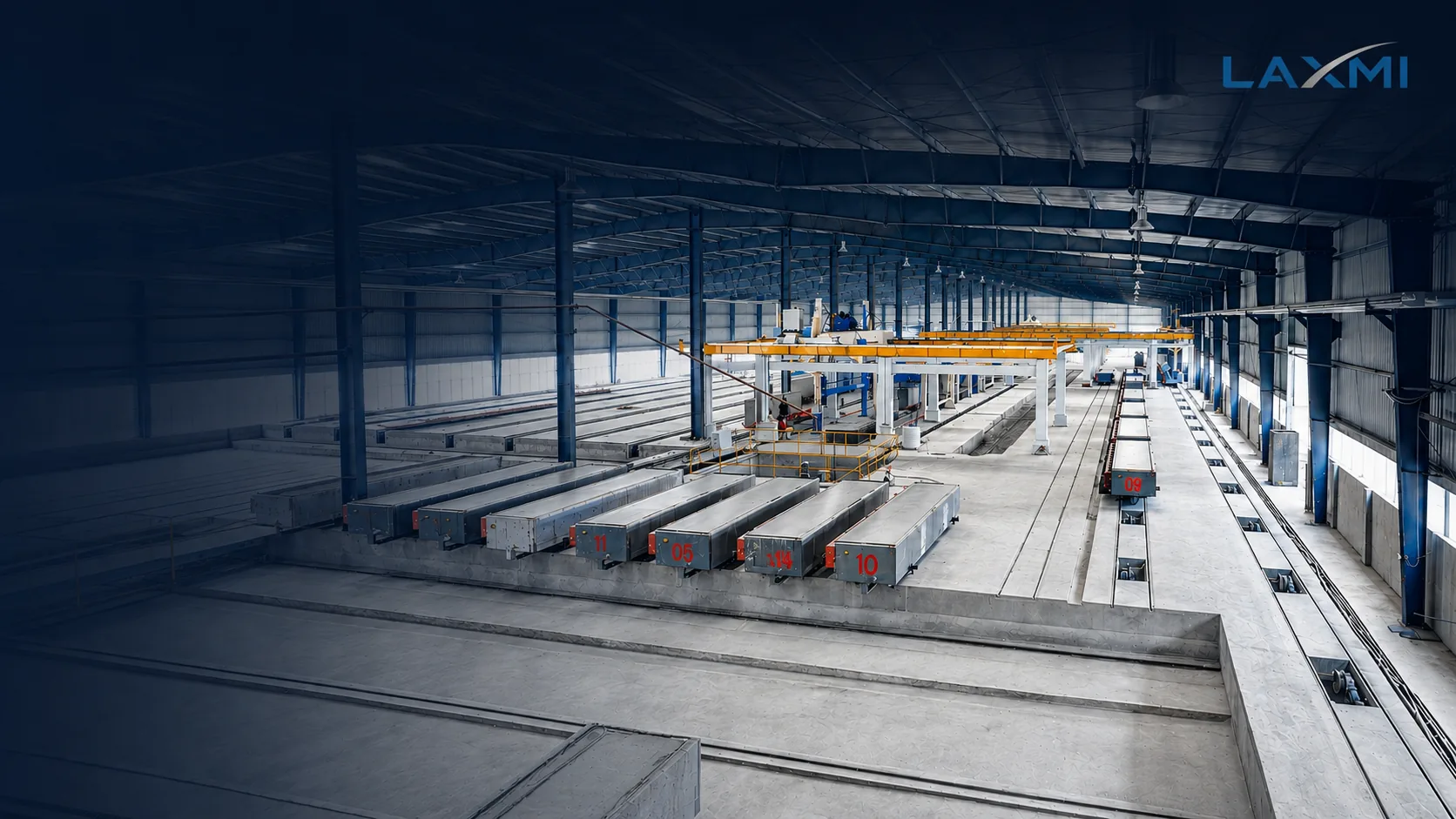
AAC PLANT PROCESS ENGINEERING
A balanced AAC mould handling and precuring system connects pouring, initial setting, tilting, cutting and side-plate return—without treating each machine as an isolated purchase.
For new AAC plants, expansions and circulation retrofits.
DIRECT ANSWER
An AAC mould handling and precuring system moves filled moulds from pouring to controlled initial setting, then positions the green cake for demoulding and cutting.
Its engineering purpose is to keep moulds, side plates, transfer equipment and downstream machines circulating at the rate required by the production plan. If one part is undersized or poorly sequenced, it can restrict otherwise capable equipment.
THE CENTRAL ENGINEERING QUESTION
THE COMPLETE CYCLE
The process is continuous. Each movement affects the next pour, the cutting line and the availability of production carriers downstream.
Clean, inspect and apply release oil to the empty mould.
Position the mould and receive the prepared AAC mix.
Move the filled mould into the designated precuring area.
Allow the cake to rise and develop cutting-ready green strength.
Position the mould and green cake for demoulding and cutting.
Return the mould; continue the side plate with the cake.
SYSTEM SCOPE
Final equipment scope is project-specific. These elements must be selected together and checked against the plant layout and planned cycle.
Contains the poured mix during rising and initial setting.
Transfers moulds across or between production tracks.
Provides the holding space and controlled process environment.
Positions the green cake for demoulding and cutting.
Prepares each empty mould for its next production cycle.
Coordinate movement, confirm positions and prevent conflicts.
PRECURING CONTROL
Precuring allows the poured material to rise and develop the green strength required for demoulding and wire cutting.
Industry references often describe approximately two to three hours. But actual cutting readiness depends on the raw-material source, recipe, slurry temperature, aluminium reaction, cake size and process conditions. It is not a universal fixed guarantee.
A closed or controlled enclosure may help where ambient variation affects production. The heating method, circulation, control point and operating range must be established during process engineering. Recoverable heat may be considered only through an engineered heat-exchange arrangement with the necessary steam-balance and safety review.
CYCLE-BASED EQUIPMENT SIZING
Mould quantity must be derived from the production schedule, not selected as an independent purchase number.
Total mould-cycle time
÷
Planned pouring interval
THE KEY DISTINCTION
The two items perform different functions and remain occupied for different lengths of time. Their quantities should therefore be calculated separately.
| Circulation item | Main stages | Primary quantity driver |
|---|---|---|
| Mould box | Pouring → precuring → tilting → cleaning/oiling → return | Mould-cycle time and pouring interval |
| Side plate | Cutting → handling → autoclave loading → autoclaving → unloading → return | Complete downstream and autoclave schedule |
The precise ratio is project-specific. It depends on the cutting route, autoclave arrangement, loading pattern, production shifts and side-plate return path.
AUTOMATE INTELLIGENTLY
“Automatic” is meaningful only when movement, positioning, confirmation, interlocking and recovery functions are clearly described.
Operator-led movement where cycle demand and the risk assessment permit manual involvement.
Check labour dependency, ergonomics, safe movement and future capacity.Powered movement at selected points while some sequencing remains operator controlled.
Check remaining decisions, position confirmation and interface bottlenecks.Interlinked drives, sensors and logic sequence mould movement between defined positions.
Check controls skill, fault recovery, sensor reliability and maintenance discipline.COMMON DESIGN ERRORS
Selecting mould quantity only from daily capacity.
Assuming mould and side-plate quantities are equal.
Treating precuring as a fixed waiting time.
Motorising movement without sequencing and interlocks.
Ignoring expansion space in the original track layout.
Accepting poor rail and transfer-interface alignment.
ENGINEERING INPUTS
A useful technical discussion begins with a small set of project-specific inputs.
New plant, expansion or retrofit
Net capacity and planned operating hours
Dimensions and usable cake volume, if selected
Fly ash, pond ash, sand or approved combination
Track plan, dimensions and expansion area
Cutting route, autoclaves and loading sequence
PRACTICAL QUESTIONS
Precuring allows the poured AAC mix to rise and develop sufficient green strength for the selected demoulding and wire-cutting process.
Industry references often describe approximately two to three hours, but actual cutting readiness depends on raw materials, recipe, temperature, cake size and the plant's approved control method. It should not be treated as a universal fixed time.
There is no universal setpoint for every AAC plant. The operating range and measurement point should be established from the raw-material system, mix behaviour, enclosure design and validated production trials.
The preliminary quantity is based on total mould-cycle time divided by the planned pouring interval, then checked against physical positions, operating allowance, maintenance and standby requirements.
The mould can return after demoulding, while the side plate may remain occupied through cutting, autoclaving and return. The two circulation quantities must therefore be calculated separately.
A retrofit may be possible after reviewing track condition, layout, mould interfaces, production sequence, controls, civil constraints and the required capacity improvement.
PLAN THE COMPLETE CIRCULATION
Share your target capacity, mould size, planned operating hours and available layout. Receive a focused technical discussion covering moulds, side plates, ferry carts, precuring positions and the suitable automation approach.