Batching & pouring
Usable batch volume and sustainable casting frequency establish the production rhythm.
AAC Investor Academy · Plant Design
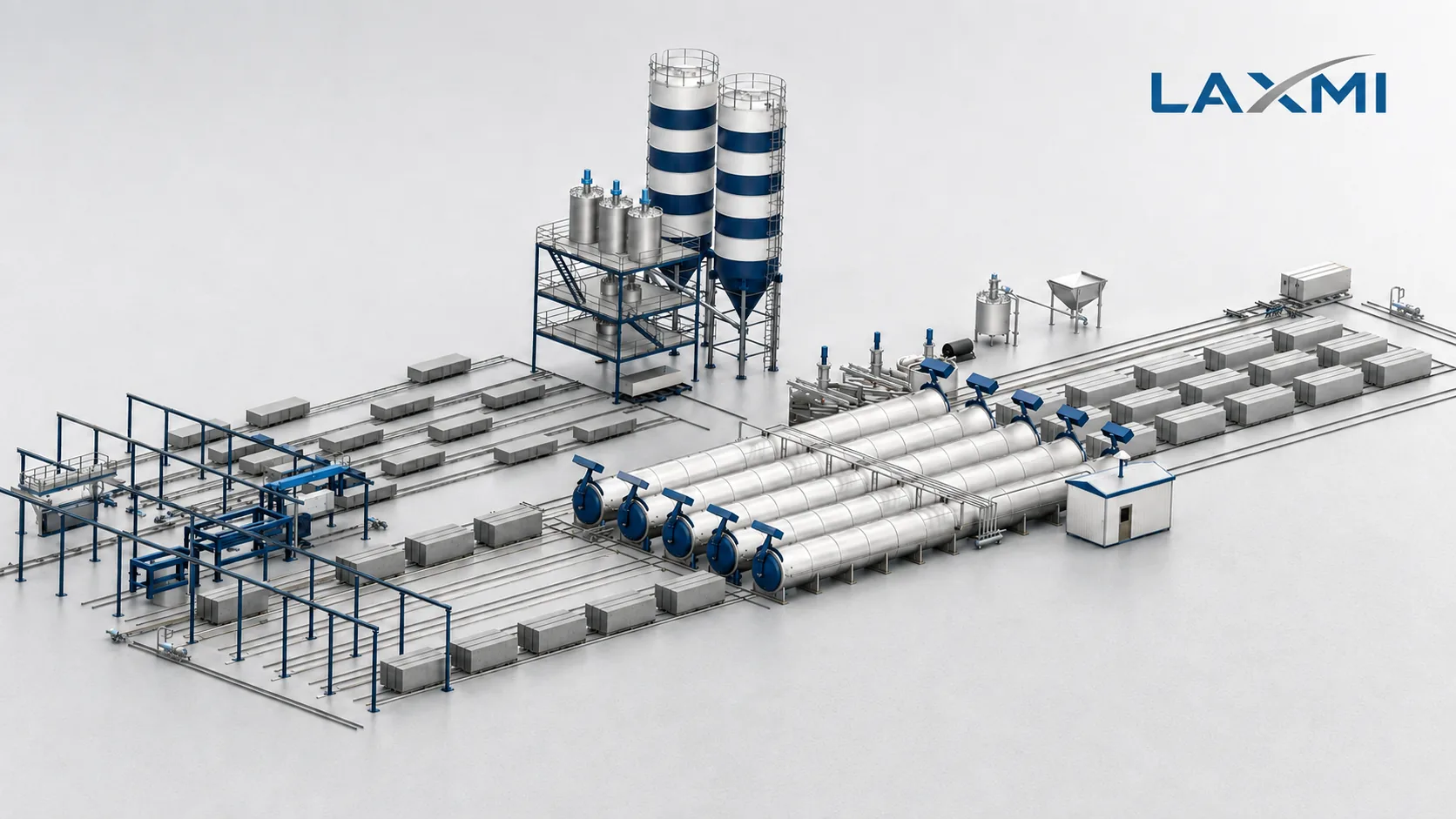
Batch size establishes the production platform. Sustainable capacity depends on how the complete line performs—from casting and pre-curing to cutting, autoclaving and packing.
For new plants, phased investment and expansion planning.
The direct answer
Batch size is a major platform-selection factor, but it does not determine daily saleable output by itself.
The slowest integrated stage becomes the practical limit. That is why two plants described with the same batch size may deliver different sustainable production.
01 · Read the complete line
Every production stage must sustain the same flow under one consistent set of assumptions.
Usable batch volume and sustainable casting frequency establish the production rhythm.
Mould quantity and pre-curing duration must sustain every planned casting cycle.
Cranes, tilting and cutting must process each cake without creating a queue.
Curing, steam and finished-product handling must match the upstream flow.
Planning framework
Gross casting output = usable volume per batch × sustainable batches per hour × scheduled casting hours.
02 · Compare like with like
“Batch size” is often used loosely. Before comparing quotations, establish exactly which volume the supplier is quoting.
The total physical mixer volume; not necessarily the safe working volume.
The actual slurry volume prepared and discharged in a normal cycle.
The cake volume moving through cutting and curing after process allowances.
Accepted finished product after breakage, rejection and quality losses.
03 · Select the production platform
These company-supplied ranges are an initial capacity-planning reference, not universal production guarantees.
| Batch platform | Viable starting capacity | Semi-automatic range | Fully automatic range |
|---|---|---|---|
| 1.0 m³ | About 100 m³/day | 125–150 m³/day | 125–150 m³/day |
| 3.0 m³ | About 200–250 m³/day | 600–700 m³/day | Up to 900 m³/day |
| 3.45 m³ | About 400–500 m³/day | 800–900 m³/day | 1,000–1,100 m³/day |
| 4.32 m³ | About 700–800 m³/day | Around 1,200 m³/day | 1,500–1,700 m³/day |
Important: Final output depends on the approved process design, product mix, mould and autoclave configuration, operating hours, utilities, raw materials, staffing, maintenance and performance-test conditions.
Integrated capacity planning · Laxmi En-Fab engineering visual
04 · Plan the expansion boundary
A larger batch platform may begin at lower output when phased operation is engineered from the start. The initial design must identify what is installed now, what is sized for the future, and what can be added without major shutdown or civil modification.
Batch and mould platform, main material flow, expansion space, building clearances and utility routes.
Autoclaves, mould inventory, boiler capacity, packing modules and selected automation functions.
Adding autoclaves helps when autoclaving is the verified bottleneck and the rest of the production line has spare capacity.
Expand the constrained process—not simply the most visible machine.
05 · Define the automation scope
“Fully automatic” is not a sufficient capacity specification. The same label can describe very different machine and material-transfer scopes.
Semi-automatic
Fully automatic
06 · Verify before investing
What are the usable batch volume and mould dimensions?
What is the sustainable—not fastest observed—casting frequency?
Which shifts and casting hours support the daily claim?
How many moulds are required at the stated pre-curing duration?
Can the cutting line and cranes sustain the same cycle?
What are the autoclave loading pattern and curing schedule?
How does the steam system support the planned loading sequence?
Can separation, packing and dispatch sustain the output?
Which utilisation, downtime and rejection allowances are used?
How will commissioned performance be measured and accepted?
Technical questions
Short answers to questions that change plant configuration and quotation comparison.
Not necessarily. Ask the supplier to state mixer gross volume, usable slurry volume, mould volume and net cake volume separately.
No. Practical output is limited by the slowest sustainable stage across material preparation, casting, pre-curing, cutting, autoclaving and packing.
Yes—when autoclaving is the verified bottleneck and the rest of the line has spare capacity. Additional autoclaves cannot correct a restriction elsewhere.
It may be possible through phased engineering, provided the initial layout, main platform, utilities and expansion provisions are planned from the beginning.
No. Automation improves throughput only when it removes the active constraint and the remaining systems can sustain the faster flow.
Define the product, quality parameters, operating hours, utilities, raw materials, staffing, test duration, permitted downtime and acceptance method—not only a headline m³/day figure.
Capacity planning by Laxmi En-Fab
Share your target output, product mix, operating plan, project location and expansion objective. Our team can review the batch platform and identify likely capacity constraints.